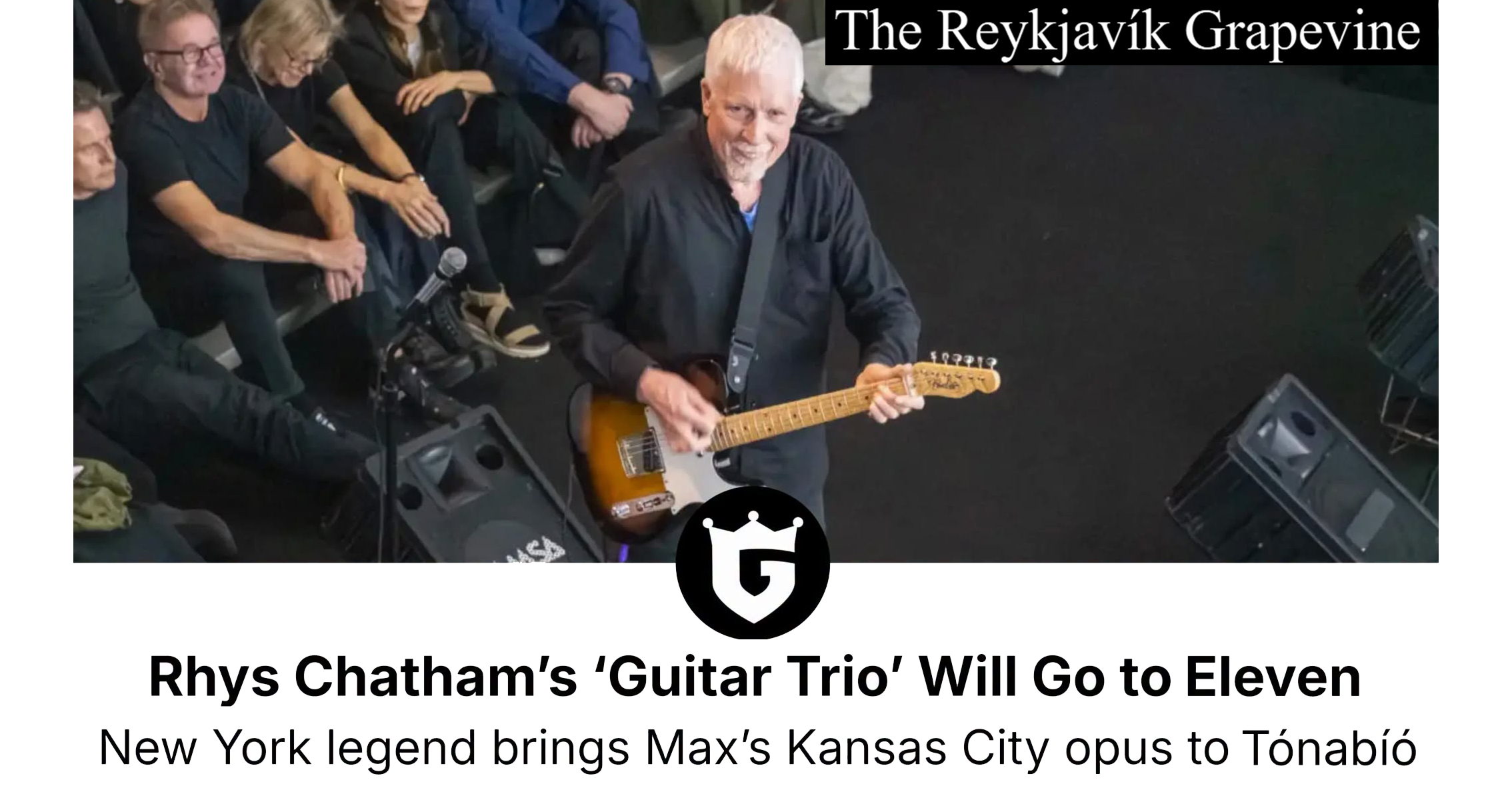
I met Rhys and fellow Frenchman Nico Guerrero, who has lived in Iceland since 2010, along with their youngest collaborator, 24-year-old Stirnir Kjartansson.
Grapevine: Your timing is a little off. Did you know that here in Reykjavik the National Gallery Museum featured an exhibit of Woody and Steina Vasulka and their work at The Kitchen that ran from last October until early January? Maybe you would have come and tried to come sooner.
Rhys: I would have. I put the music on Woody and Steina’s electronic image projects. We got to know each other that way. And they invited me to do a series at The Kitchen, which was primarily about electronic music, minimalism, and of improvisation. I founded the music program there in 1971, and it was primarily a space for electronic image.
Grapevine: Rhys, what was the downtown New York music scene like then?
Rhys: By the mid-1970s, Patti Smith, Richard Hell, and Television were playing at this dive called CBGB. The Talking Heads would play and 10 people would show up to the concert.
Grapevine: Nico, how do you remember your first meeting?
Nico: The first time I went to Rhys’s studio, we improvised. I knew a lot about his music. Days before, I anticipated playing with him, preparing a specific sound with electronics and my guitar, different filters and programs. Rhys, you told me, “You can begin now.” I didn’t know exactly what to do. I asked about what key and you said, “I don’t know. Just listen.” It worked.
Rhys: The way we arrived at the music was the same way Stravinsky arrived at all of his music… through improvisation on piano. When he found something that sounded right, he wrote it down. And in a way, as Nico said, we started out by improvising, and then we added the structure later.
Grapevine: Was your new release, Athanor, composed in advance or improvised?
Rhys: I’m going to start just by saying that we rehearsed the piece after not having played it in a few years, and everything’s written down in notation. I had completely forgotten all the cues and everything. We just read down the score. And man, we nailed it the first time. The score isn’t notes. It’s verbal notation. Prose like “play a flurry of notes,” and we have timings for each of these notations.
The guitar trio
Grapevine: Let’s talk about the Guitar Trio. Was 100 the most amount of guitars you done?
Rhys: We were supposed to be 400, but there was a scholastic holiday and all the kids were, you know, all the college kids were on vacation. So we only got 126. I found the sound was kind of confused because the way Guitar Trio works, it is largely rhythmic improvisation. I ask the players to find something that works with the characteristic riff I’m playing.
My idea then was that I didn’t want to be a “composer” coming out of a classical context that was colonising the rock scene. I wanted to make a piece that was not to be performed in art spaces but in rock clubs.
Grapevine: Did you see Stirnir play somewhere?
Nico: It was a music school. You played with six or seven guitars. It was impressive.
Stirnir: Yeah, it was seven guitars at the Iceland Academy of the Arts. We’ve gone up to nine. It’s very much inspired by Rhys. So it’s, yeah, I’m so excited to play a guitar trio, you know, because like I’ve obviously listened to so many.
Stirnir: I think you can’t really experience it unless you hear it in person live [like Guitar Trio] because the loudness is such a physical experience. That can’t really be captured in a recording.
Harmonics and voices
When you put three or six of them together, you get this effect that sounds like choirs of angels singing.
Rhys: We’re playing one note, a low E. The whole point is that we’re listening to the harmonics that are generated by that one E [chord]. That’s how I got my start. I tuned for Glenn Gould’s harpsichord. The thing about harmonics, they’re soft, right? When you play on your guitar, you can turn the volume up. When you put three or six of them together, you get this effect that sounds like choirs of angels singing.
People would go back to the sound board and ask, “Where are you hiding the singers? We hear singers.” They were hearing the harmonics, of course. So I knew at that moment that I’d succeeded in what I wanted to do… make a new kind of minimalism that would work in a rock club, but also if you had a master’s degree in music and could hear harmonics. It’s something that different audiences hear different things.
Grapevine: Nico, you told me yesterday you heard ghosts.
Nico: On stage, we can hear voices or ghost sounds. It’s like magic.
Rhys: Larry, that’s a closely guarded secret. We play directly over the fretboard the entire time when we’re playing. We use the dot system. You know, we play over the 12th fret, the 15th fret. You can tell your readers that we use this technique, but you must promise to not to tell anybody else.
Grapevine: You have my word.
Rhys: I can’t wait to meet everybody. We’re going to have a blast!
On June 20 at Mengi, Rhys and Nico Guerrero play their newly released duet album, Athanor, released by the US indie label, Erototox Decodings, on Bandcamp and limited-edition vinyl.
On June 21, Rhys, Nico, Stirnir, and eight other local guitarists will play Rhys’s opus, “Guitar Trio” at Tónabíó, which debuted with just three guitars at Manhattan’s Max’s Kansas City in 1977. Additional musicians include: R.Michael Hendrix; Ronja; Masaya Osaki; Tobias Daoud; Oscar B.C.; Vigfús Þór Eiríksson; Sturla Sigurðarson; Tristan Zand (bass); and Sólrún Mjöll Kjartansdóttir (drums).