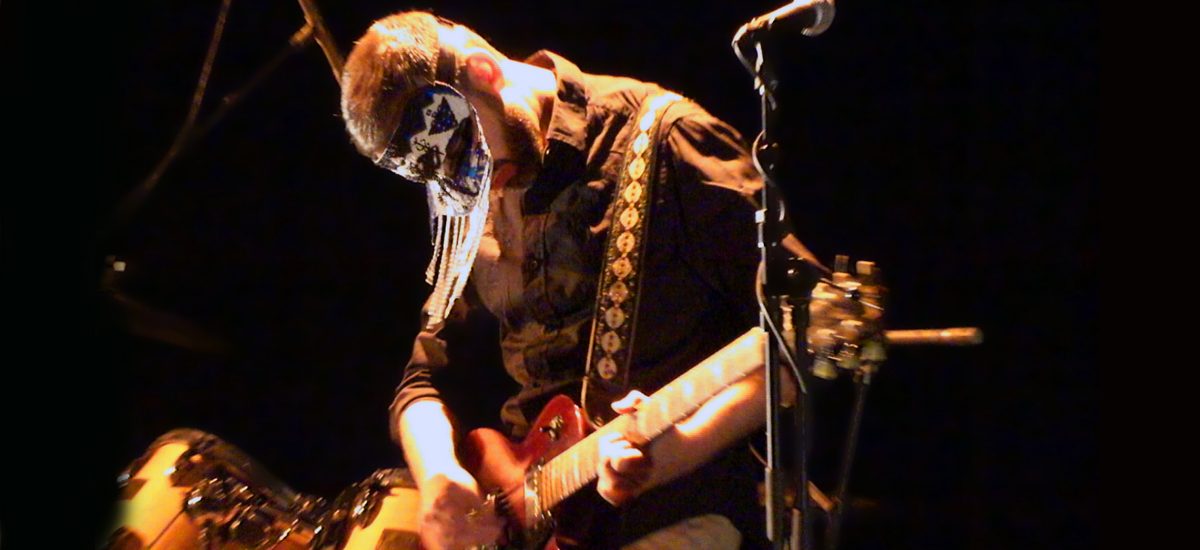
Nico Guerrero is a French experimental composer and guitarist whose work explores the outer edges of drone, minimalism, and sonic ritual. He first emerged in the early 90’s with Vortex, a dark shoegaze project that established his interest in dense textures and immersive atmospheres. The debut album Eksaïphnès (Les Disques du Soleil et de l’Acier, 2000) already outlined the core of his aesthetic: a frozen, cosmic, and noise-infused universe that he currently continue to expand in solo.
Working with a setup centered around a single electric guitar transformed through occult electronic processes—Nico Guerrero crafts vast sonic architectures. His music unfolds as a play of overtones and resonances, where strings bloom into organ-like clusters and dissolve into swirling fields of sound. Within this dense, almost symphonic space, ghostly harmonics and shifting frequencies emerge, suggesting a form of controlled chaos shaped by both intuition and discipline.
In 2015, Guerrero began a close collaboration with American composer Rhys Chatham, creating a poly-instrumental work for electric guitars, flute, and trumpet. Their partnership extended to studio recordings, live duets, and large-scale performances, including the co-conduction of Chatham’s Symphony for 100 Guitars in Le Havre in June 2018 or for Hermès in Paris in June 2025.
His 2019 release Live at the Nordic House, recorded during the Iceland Airwaves festival, reflects a deep connection to Iceland’s stark landscapes and solitude. The album channels a sense of isolation and reverence, paying tribute to influences such as Coil—with a cover of “A Cold Cell”—and echoing the spectral presence of Nico (of The Velvet Underground) in pieces like “Clepsydra.”
After the release of his piece “Horus Rising” for the Dark Indicator 2 – Guitar & String Drones Collection (2020) on Silent Records label, a new studio album Streams of Oblivion followed in 2021, conceived entirely in Reykjavík during the winter months and later recorded and mixed in Paris. Built from layered electric guitars, the work evokes a vast “cathedral of sound,” drawing on esoteric symbolism and Icelandic telluric forces—volcanoes, hidden entities, and mythic presences.